Team pzkpfw built this human powered Panzer Kampwagen III in 11 days that was intended to crash the party at the 2nd annual Kensington Kinetic Sculpture Derby. Currently the DIY tank is installed as public art in Philadelphia.
Sunday, February 20, 2011
Saturday, February 19, 2011
Little Plane, Big Machine Guns
Strangely, it is harder to take down a flimsy little model airplane with this kind of artillery than it is to shoot down a real one.
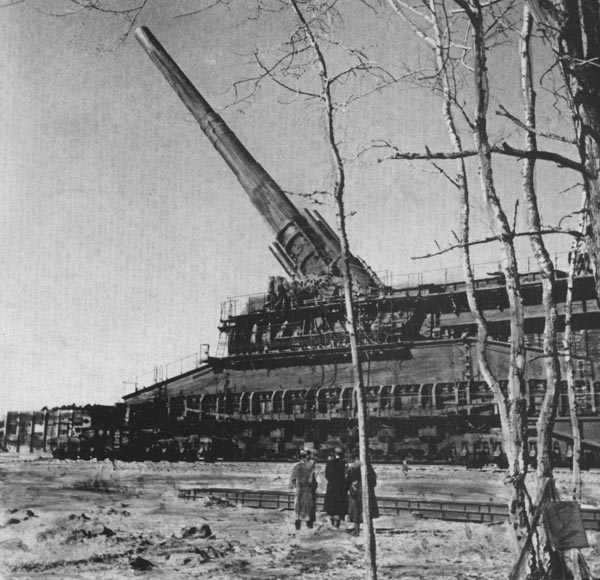
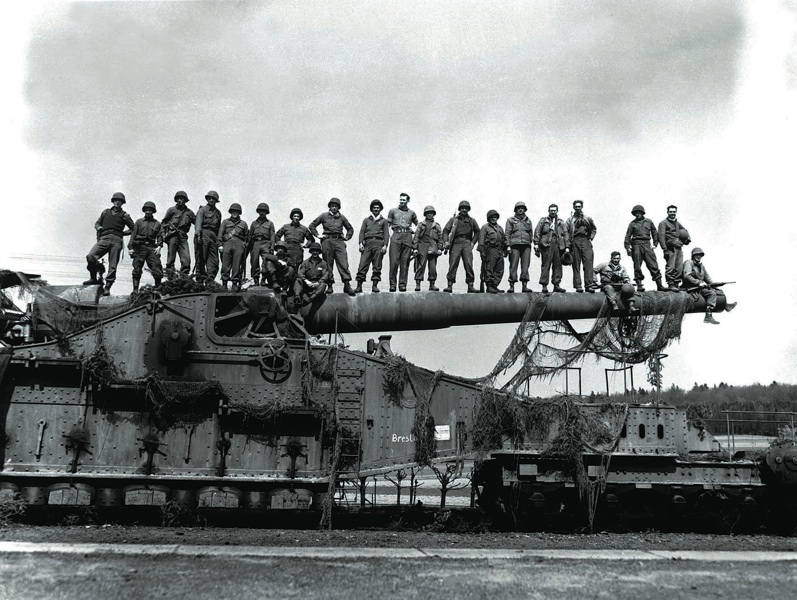
Gustav Gun - The Largest Gun Ever Built
Two types of projectiles were fired using a 3000lb. charge of smokeless powder: a 10,584 lb. high explosive (HE) shell and a 16,540 lb. concrete-piercing projectile. Craters from the HE shells measured 30-ft. wide and 30-ft. deep while the concrete piercing projectile proved capable of penetrating 264-ft. of reinforced concrete before exploding! Maximum range was 23 miles with HE shells and 29 miles with concrete piercing projectiles. Muzzle velocity was approximately 2700 f.p.s.
Three guns were ordered in 1939. Alfried Krupp personally hosted Hitler and Albert Speer (Minister of Armaments) at the Hugenwald Proving Ground during formal acceptance trials of the Gustav Gun in the spring of 1941. In keeping with company tradition, Krupp refrained from charging for the first gun - 7 million Deutsch Marks were charged for the second (named Dora after the chief engineer's wife).
France fell in 1940 without the assistance of the Gustav Gun, so new targets were sought. Plans to use Gustav against the British fortress of Gibraltar were scrapped after General Franco refused permission to fire the gun from Spanish soil. Thus, April 1942 found the Gustav Gun emplaced outside the heavily fortified port city of Sebastopol in the Soviet Union. Under fire from Gustav and other heavy artillery, Forts Stalin, Lenin and Maxim Gorki crumbled and fell. One round from Gustav destroyed a Russion ammunition dump 100 feet below Severnaya Bay; a near miss capsized a large ship in the harbor. Gustav fired 300 rounds during the siege wearing out the original barrel in the process. Dora was set up west of Stalingrad in mid-August but hurriedly withdrawn in September to avoid capture. Gustav next appeared outside Warsaw, Poland, where it fired 30 rounds into Warsaw Ghetto during the 1944 uprising.
Dora was blown up by German engineers in April 1945 near Oberlichtnau, Germany, to avoid capture by the Russian Army. The incomplete third gun was scrapped at the factory by the British Army when they captured Essen. Gustav was captured intact by the U.S. Army near Metzendorf, Germany, in June 1945. Shortly after, it was cut up for scrap thus ending the story of the Gustav Gun.
Credits: Printed in the American Rifleman, February 1998. Page 26.
Booby Traps of the Vietnam War
A booby trap is a device set up to be triggered by an unsuspecting victim. As the word trap implies, they often have some form of bait designed to lure the victim towards it. However, in other cases the device is triggered when the victim performs some type of everyday action e.g. opening a door, picking something up or switching something on. Lethal booby traps are often used in warfare, particularly guerilla warfare, and traps designed to cause injury or pain are also sometimes used by criminals wanting to protect drugs or other illicit property, and by some owners of legal property who wish to protect it from theft. Booby traps which merely cause discomfort or embarrassment are a popular form of practical joke.


Trap used by Vietnamese, at Cu Chi Tunnels.